Wednesday, May 30, 2012

Exploring Color Palettes


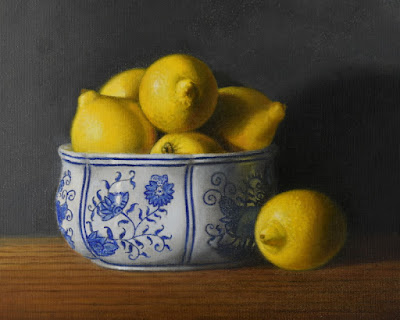
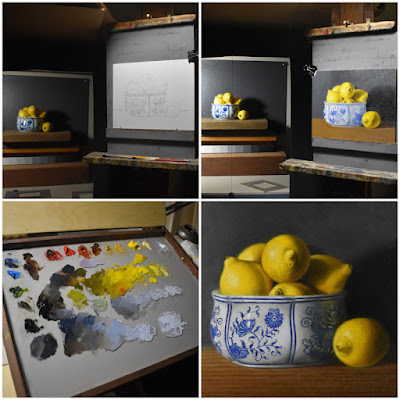
How a painter lays out the colors of their palette and the colors they choose is an insight into their painting process. A artist looks at the arrangement of paint piles on a wooden palette as the musician looks at the strings of a guitar. They represent the creative possibilities of describing the visual world through color. Color is described by three qualities hue, value and chroma, together those three components are referred to as a “color note”. So when you look at a thing and say I will describe it with paint, you are actually saying, I will create in some abstract pictorial space that exact shape in hue, value and color with a brushstroke. Or more exactly a color note.

My palette charts are based on a limited palette of yellow ochre, burnt sienna, burnt umber, and ultramarine blue, which offer a surprising range of color and value relationships on their own. The pure color is on the left with two steps of white.  I have written about earth palettes and limited palettes here before, you may want to read those articles also.


The greatest masterpieces were once only pigments on a palette. 
(Henry S. Hoskins)


These color notes come from an array of pigments spread across a palette, learning to control and understand that palette is important. Building knowledge of their relationships and how colors interact is much like (using the music analogy again) learning the scales. Most students start with a limited palette of colors and as they become knowledgeable of how they interact, expand the palette slowly.

The idea is to develop a method of working with color that becomes intuitive, color mixing should be a non-cognitive action so that you can find a color note quickly and effectively without interfering with your creative process. Clapton never stopped in the middle of a guitar solo and said, “Crap, where’s the key of C ?”


Expanding on this core set of earth colors I selected colors that would give me further variations on the primaries, a warm and cool in each family with some colors of convenience and modifiers such as sap green and raw umber. The experience of making puddles of paint and experimenting with them to learn which colors are cool or warm, transparent or opaque, and how they relate to each other is an important part of understanding color harmony and color mixing.


This last palette is a classical palette I have come across a few times and experimented with, how historically accurate it is I am not sure. However Gamblins Oil Colors, which is a very reputable source sold this set of colors as an Old Master Palette. With lots of warm earth tones and contrast this palette really has that old master feel to it. I could see Titian or Rembrandt using this palette. A good resource for the history of paints used by artists is Pigments Through the Ages.


Everything that you can see in the world around you presents itself to your eyes only as an arrangement of patches of different colors. 
(John Ruskin)


Links
Three Color Palette
Earth Palette

Explore - Question - Learn - Enjoy, Jim Serrett

Monday, April 16, 2012

Google Art Project Updated


Most artists I believe, are familiar with the Google Art Project launched back in February 2011; based on Google’s Street View technology we were able to wander virtually through 17 partner museums by clicking on the gallery’s floor plan.


In their second launch Google has added another 151 galleries and museums to its Art Project, the platform features over 32,000 artworks from 46 museums. One nice feature is the ability to select either "Museum View" or "Artwork View" for each museum.


The updated interface and new search features allow the user to find artworks by period or type of artist. You can look at the collections within one museum, or the collective inventory of one artist in all participating museums. Above are the results from selecting "Artist", then Albrecht Durer, which gave me 45 works that I can scroll through or play as a slideshow.


The image quality is excellent, and the zoom tool will make you think you are actually there. The "My Galleries" tool allows you to create/save/share your own virtual gallery (look out Pinterest) from some of the most prestigious museums in the world. I promise you that hours can vaporize on this site, just keep reminding yourself of how great an educational tool and resource this is.

Explore - Question - Learn - Enjoy, Jim

Thursday, March 29, 2012

Bottle Collection + Earth Tone Color Chart


Jim Serrett  Bottle Collection  Oil on panel 8x10

The painting on my easel is a study of bottles done with an earth palette.
I have really enjoyed working with these limited palettes; they have an innate natural harmony and subtlety.

The chart is the studio palette I have been using for several recent works. The color chart is comprised of just four hues, yellow ocher, burnt sienna, burnt umber, ultramarine blue, and white. These low key earth palettes will make you look closely at building color relationships and thinking about color saturation.

Much of the subtly in these color families can not truly be seen or appreciated unless you actually mix one of these charts. For example ultramarine blue mixed with burnt sienna or burnt umber produce two beautiful mixed blacks and an entire range of warm and cool grays. This is what I used in the study Bottle Collection and in the chart for my mixed black or shade.


Explore - Question - Learn - Enjoy, Jim

Saturday, February 25, 2012

Bunch of Grapes WIP


I have really enjoyed these grape paintings, they have been truly demanding. The color complements are fascinating, a very complex series of color triads that produced a natural harmony.


Seeing the bunch of grapes as a whole or mass and dealing with the individual reflective effects is not easy. Funny, is it not, how things you think will be a breeze to paint turn into some of your biggest challenges.


Painting for me is all about solving a set of visual problems, solve those visual problems and a likeness of your initial impression will emerge. Even so there are times I just have to sit and observe my subject and decide how much more to push, or should I even dare to push it more. Have I said everything I needed the image to say?. Is it saying what the image was suppose to convey? Have I kept to the “big” idea that attracted me in the first place? Am I done? Sometimes I think it is best to leave the entire visual stimulus, and return later with a fresh eye and mind. So for the time being this will be a work in progress.

“Art is never finished, only abandoned.” 
                                                                         Leonardo da Vinci


Explore - Question - Learn - Enjoy, Jim


Friday, January 27, 2012

Interview with Jacob Collins by David Yezzi


Jacob Collins, Self Portrait, 11x9

Jacob Collins is certainly one of the most accomplished realist painters of our time, his contribution as an educator is unequaled. A driving force in the Realist Revolution to revive the art of traditional painting, Collins through his schools and ateliers (Grand Central Academy / Water Street Atelier) has already trained a generation of new artists racking up an impressive list of alumni.

Collins at times seems reluctant to take on the role of leader for the movement but I can not imagine where the state of contemporary realism would be with out him.


Jacob Collins, White Peonies, 16x18

 In this great article from The New Criterion's David Yezzi interviews Jacob Collins about his life, work and the world of figurative art in which he covers Greenberg, the new aesthetic and kung-fu.


Jacob Collins, Reclining Nude Morning 32x56


An interview with Jacob Collins by David Yezzi - The New Criterion


  Links
Adelson Galleries New Works by Jacob Collins

Explore - Question - Learn - Enjoy, Jim

Saturday, December 31, 2011

Thanks for Listening II


Another year over, wow, is time accelerating? It seems to have gone by so fast and
has certainly been quite a year, one filled with the deepest sorrow and greatest joy.
I guess the ying and yang of life.

I just want to take a moment to express my appreciation to all.
Thank you for your support and interest in my work.

As I look back over the year’s efforts, the paintings that succeeded and those that did not. I ask myself the questions, have I improved? What have I said visually? Do I resonate those qualities I admire in painting/art? What I do know for certain is that the more I learn about painting the more I need to learn. It is the continued ongoing study and observation; of the nature, of the visual world that makes art so fascinating and intriguing.
It has been a great year.

Those of you that purchased work, my sincerest gratitude.

Happy Holidays and have a great New Years.
Jim


"If I could say it in words, there would be no reason to paint."
Edward Hopper

“For last year's words belong to last year's language and next year's words await another voice.”
 T. S. Eliot


Creative Commons is a nonprofit corporation dedicated to making it easier for people to share and build upon the work of others, consistent with the rules of copyright.


Explore - Question - Learn - Enjoy, Jim

Thursday, December 22, 2011

Earth Palette


Jim Serrett  Grapes on Block in Box  11"x 14" oil on panel

Like most painters I am fascinated by color palettes, those used by both contemporary artists and the Old Masters. Most artists have a set palette they work with and maybe a hand full of convenience colors they use occasionally. The pigments an artist chooses for their personal palette are an insight into their thinking and creative process. I have always been a real fan of limited palettes for the simple inherent color harmony they produce. I have written about them before on my Pochade Box site. However I find myself continually returning to the first limited palette I was introduced to, a simple four color palette of red, yellow, white and black that is characteristic of the classical color palettes.


With the "Grapes" painting I used a very basic earth toned palette, consisting of the three primaries and black and white.
Yellow Ocher (light yellow)
Raw Sienna (med orange) 
Venetian Red (red-orange) and
Ivory Black (blue)
Mixtures of ivory black and white tend to read as blue.
( You could leave the raw sienna out and  accomplish the same by mixing ocher and red. )

 I developed this little color chart by random mixtures of these earth pigments, notice how “blue” the black mixture reads when next to the warm complementary earth tones.

 These were my core colors and the majority of my mixtures began with them. In the painting I did add other colors to the palette as I worked, mostly other earth tones which I also related to as red, yellow orange – Naples Yellow (yellow), raw umber (dark yellow-green), burnt umber (dark red) alizarin (bluish red). Still a fairly monochromatic warm earth palette. I used the Alizarin Crimson and Naples yellow to punch up a hue, which in relationship to these subtle earth tones was very intense and quickly gave me a new appreciation of the high chroma pigments.


  In this comparison you can clearly see the limited earth color palette in the pixellated image.


Many of the Masters used similar limited palettes, based on a yellow, red, white and black substituted as a blue. Rembrandt, Velasquez, Goya certainly used something along the lines of a earth toned primary palette. And of course Anders Zorn’s legendary four color palette of Yellow Ocher, Cadmium Red Medium, Ivory Black plus White. One could argue that many painters before the 19th century just did not have access to many pigments. But after the turn of the century and a whole world of tube colors at the artists reach these pigments remain.

The earth tone palette is perfect for matching the colors of the natural world. Painting from direct observation with a limited palette will force you see the subtleties of each color note you mix. You will pay closer attention to the color bias and its temperature. Using a earth tone palette you can work with color and still emphasize tonal values. This “family” of closely related earth tone colors lend themselves perfectly to producing light and shade and is one of the reasons that great artists, Rembrandt, Titian, Rubens, and Hals have produced such a large spectrum of colors from such a small core of pigments.

I see this simple harmonizing core of earth toned primaries inside almost all of the major representational painters I admire.
One of my favorite artists, Winslow Homer's palette was based on a low keyed palette of earth colors augmented with some umber and a blue.

Interesting that Edgar Payne, one of the most noted and misunderstood American landscape painters (this man was not an impressionist no matter what the “plein-air” crowd wants to believe, just look at his theories and practices) used a mixture of red, yellow, and blue as a harmonizer, which he referred to as the “soup” in his paintings. A neutral gray tone that is made from a mixture of Indian red, ultramarine blue, and a bit of yellow.

Why, because Payne knew just like the old masters that the best way to create harmony is by complementary mixtures, being that by each color mix having a bit of the colored "soup", assures a unity and harmony overall in the painting. Painting, especially “color” is about relationships, what happens to one color when next to another, how does it effect hue, value, chroma? Obviously there is a infinite number of colors we see in the world and attempting to match all those color notes let alone harmonies without some type of color “theory” would be overwhelming. Now, before we go off track here, I want to say there are endless books written on color theory. And I highly recommend Michael Wilcox's books on color. There are many other good ones in fact, but trying to understand color and how it works with out pulling out some paints and brushes is like trying to play the piano by looking at it.

 What Edgar Paynes "soup" tells us is that gray is the combination of the three primaries red, yellow and blue, understanding that gray can be warm, cool or neutral is important to understanding its use as an unifying color.
 The method or genius of a limited palette is that the complement of each color is the mixture of the other two colors, no easier way to use and harmonize color than to mix it from the primaries.

As I meander around with this discussion I thought it might be helpful to state what benefits I see in a limited earth palette. First everything we do as painters is directed to developing knowledge about how to manipulate hue, value and chroma.

1.Earth tones are not neutral; they are cool or warm and are the duller and darker; version of yellow, orange and red. (lower chroma)
2.Color must be seen in relationship - you must always look at the effect one color has on another. Verbally saying that, “that is a red apple” is much different than visually saying that.
3.Black is a Color - it can be abused, but no matter what your high school art teacher told you, you can use it as a modifier.
4.Mix Neutrals with Complementary Colors - Mix any two color complements in unequal parts with white and you will create a range of neutral grays. These grays will have an innate harmony and unity.
5. Keep it Simple – a limited palette will force you to do more with less - Mixing paint using only the primaries and gray will force you to look at each color note, and ask what is its hue, value, chroma and temperature


Eugene Delacroix's Palette

I think it boils down to this, as artists/painters we must develop an instinctive understanding of the colors on our palette. By developing a personal color palette with the fewest number of colors, based on core color that we subconsciously understand we can most effectively bring expression to the subject we see.


Virgil Elliot in his book "Traditional Oil Painting" touches on this subject recommending a beginning palette of Ivory black, white, yellow ocher (or raw sienna) and red ocher (or other red earth) saying, “As the student becomes familiar with the palette and more confident in its use, the palette is expanded gradually by the addition of burnt sienna, raw umber, and cadmium red light, or cadmium vermilion. At the appropriate point, ultramarine blue is added, and so on, so that no lesson overwhelms the student with too much new to learn at once.”


One of the most interesting physical palettes that exist is that of Delacroix’s.
It was documented that he would methodically mix dozens of color on his palette.
The arrangement is unique and inundated with beautiful neutrals and earth tones.


  "I can paint you the skin of Venus with mud, provided you let me surround it as I will."
 
     Eugene Delacroix


Eugene Delacroix, Liberty Leading the People, 1830 Louvre

Links

Great site ran by artist Aaron Miller, about artist palettes.
Fantastic info and demo about the Zorn palette by artist Michael Lynn Adams.
Virgil Elliott
Elliot, Virgil. Traditional Oil Painting. New York: Watson-Guptill Publications, 2007
Michael Wilcox, Blue and Yellow Don't Make Green


Explore - Question - Learn - Enjoy, Jim

Sunday, November 20, 2011

Practice, practice, practice


  There is no doubt that the answer to developing as a painter requires a lot of perseverance and practice, practice, practice. Small studies from life are an excellent means to improve painting skills and focus on the simple truthful depiction of the thing observed.


I learn a great deal from repeating subjects, I have no idea how many pears or apple I’ve painted. But each time I paint one I feel I have seen something new and unique and tried to express that in the final image.

An artist must be engaged with the image in front of them. It is that personal direct experience with a subject which will develop the thinking process and aesthetic sense in a artist.


 After nearly twenty years of “wall dogging” advertising art, I am pretty certain that paintings done from nature are at a minimum more interesting and beautiful than those done from photography.  However I am completely certain that painting from life is a thousand times more challenging than painting photorealism.
After all that “is” just paintings of photographs.

I think we forget that this is hard work and a tough road at times.
That only by perfecting our understanding of the craft of painting, learning traditional methods and techniques and pushing our skill level, will an artist develop the language necessary to express themselves.


 We see nothing truly until we understand it. 


 John Constable The Complete Works
http://www.john-constable.org/


                                                                  Explore - Question - Learn - Enjoy, Jim

Monday, October 31, 2011

Grapes WIP


Like most artists today I get much of my art “fix” online. I have a multitude of blogs, online magazines, and forums I read, browse and contribute to regularly. I truly enjoy seeing the creative process, and most painters do not have any issues with showing you how they produce work or come to their ideas and concepts.

 In fact through this medium the web-blog, I think artists that share their process and join into the creative commons have helped secure a footing in the contemporary world of art for representational painting.

This painting is still in process, I am focusing on the treatment of edges, attempting to keep every thing very soft and atmospheric. 

Grapes - WIP - oil on panel, 11x14


Explore - Question - Learn - Enjoy, Jim

Saturday, September 24, 2011

A Darwinian Theory of Beauty

Denis Dutton: a Darwinian Theory of Beauty on TED


I've watched this video from the late Denis Dutton several times.  Dutton has some very unique insights on the aesthetics of beauty and the animation is really entertaining.


Explore - Question - Learn - Enjoy,  Jim